Spelling
Our teaching of spelling in Y1 – Y6 is supported by Read, Write, Inc and an online progressive scheme ‘Spelling Shed’, which can also be accessed at home. This is taught regularly through the week in a designated timetabled slot alongside writing lessons. Using a range of online activities, teaching activities and peer to peer work, our children are introduced to spelling rules and strategies which they can then apply to their independent written work.
How Does Spelling Shed Use The Science of Spelling to Deliver Effective Spelling Lessons?
To deliver effective spelling lessons that align with the principles of the Science of Spelling, we must focus on research-backed approaches. This means teaching strategies rather than memorising them. These strategies include direct instruction, word study and practice. Spelling Shed lists were developed by applying the Science of Reading research and follow a systematic progression of phonics and word study skills typically addressed in each Stage.
At the beginning of each Stage, there is an intentional spiral review of skills expected to have been acquired in the previous Stage but they also include words of increasing difficulty. Throughout the progression, new and more advanced concepts and skills are delicately intertwined within the review. This aids in linking past learning to the new concepts and skills and reinforces and solidifies learning. If pupils are struggling with a particular skill, teachers can use previous Stage lists, which will have a more in-depth focus to match pupils’ needs. The majority of the words selected for each list contain only the grapheme-phoneme correspondences (GPC’s) that have been previously reviewed to avoid cognitive overload, help ensure focus and attain mastery of the skill at hand.
Practising to read high frequency words is essential to becoming a fluent reader but not by memorising the whole word. Brain research shows that strong readers, even when they process a written word, such as ‘instantaneously,’ are reading by sounds. Most high-frequency words are decodable and are more efficiently taught alongside the corresponding phonetic patterns. When pupils use their knowledge of the sounds to learn and master high-frequency words, they simultaneously strengthen the skills that will enable them to read thousands more.
Handwriting
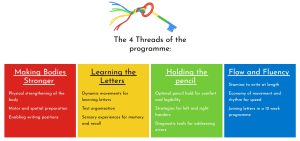
We have recently introduced the progressive handwriting scheme – Kinetic Letters. This is taught daily from Nursery – Y6 and focuses on making handwriting automatic so all the attention of the brain can be on the writing content therefore reducing cognitive load. An overview of the programme can be seen below.